
The core of Council Tax lies in its banding system, a mechanism designed to ensure that properties are taxed according to their relative value. Understanding what a Council Tax band is and how it’s calculated is crucial for managing your finances and ensuring you are being charged fairly. This article will delve into the origins of Council Tax bands, the valuation process, and the various factors that contribute to your final bill.
Understanding Council Tax Bands
At its heart, a Council Tax band is an eight-tiered classification assigned to residential properties in England, Scotland, and Wales. These bands are based on the estimated market value of a property as of a specific date in the past. The primary purpose of these bands is to create a basis for calculating the amount of Council Tax a household is liable to pay.
The Historical Context: From Poll Tax to Council Tax
The introduction of Council Tax in 1993 was a direct response to the widespread public opposition and eventual abolition of the Community Charge, often referred to as the ‘poll tax’. The poll tax, which levied a flat rate on every individual, regardless of their income or property ownership, was seen as highly unfair and regressive. Council Tax was designed to be a more equitable system, linking the tax burden to the value of the property rather than the number of occupants.
How Property Valuations for Bands Are Determined
The valuation of properties for Council Tax purposes was carried out by the Valuation Office Agency (VOA) in England and Wales, and the Scottish Assessors Association (SAA) in Scotland. Crucially, these valuations were based on the property’s market value on 1 April 1991. This historical valuation date is a key factor that often leads to discrepancies between current market values and the assigned Council Tax band.
The VOA and SAA used a range of factors to estimate these 1991 values, including:
- The physical state of the property.
- The size of the property (number of rooms, square footage).
- The location of the property.
- The age and architectural style of the property.
- The presence of any outbuildings or significant land.
It’s important to note that the VOA and SAA did not physically inspect every property. Instead, they relied on existing records, historical sales data, and broader market trends from the 1991 reference date.
The Eight Council Tax Bands Explained
Council Tax bands range from A to H, with Band A representing the lowest value properties and Band H representing the highest. The specific monetary values attributed to each band vary significantly between different local authorities. However, the relative order of value remains consistent across the country.
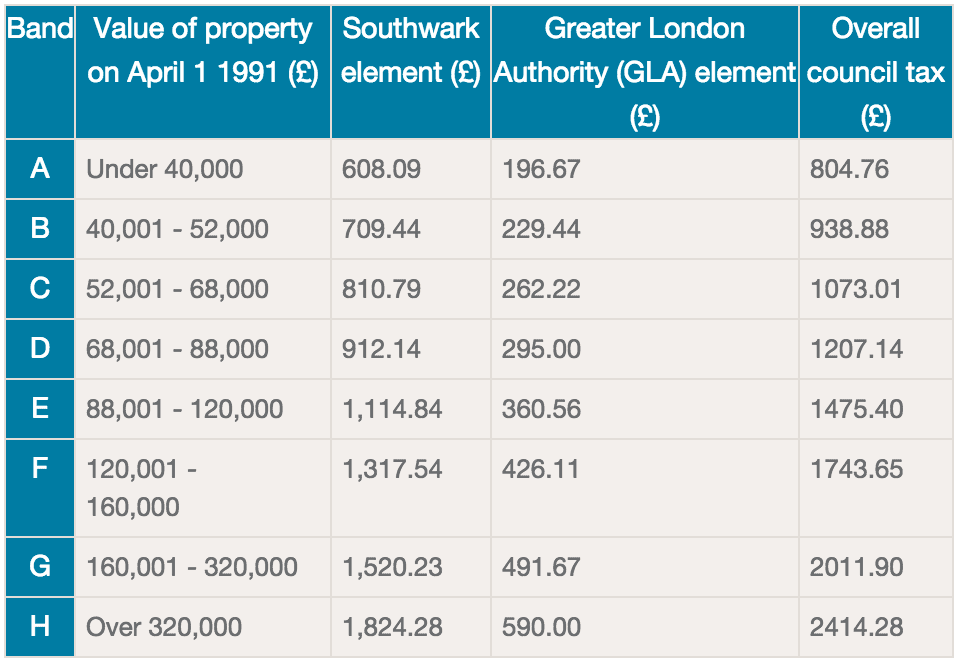
Here is a general overview of the bands and their approximate value ranges as of the 1991 valuation date:
| Band | Value Range (as of 1 April 1991) |
|---|---|
| A | Up to £40,000 |
| B | £40,001 to £52,000 |
| C | £52,001 to £68,000 |
| D | £68,001 to £88,000 |
| E | £88,001 to £120,000 |
| F | £120,001 to £160,000 |
| G | £160,001 to £320,000 |
| H | £320,001 and over |
These figures are indicative and can differ slightly depending on the specific valuation guidelines used by the VOA or SAA. The crucial point is that your Council Tax bill is directly influenced by the band your property falls into.
How Is Council Tax Calculated?
The calculation of Council Tax is a multi-step process that involves determining the overall cost of local services and then allocating this cost across the properties within the local authority’s area, based on their respective Council Tax bands.
Step 1: Local Authorities Determine Their Budget
Each year, local authorities (councils) in England, Scotland, and Wales must calculate how much money they need to provide all their services. This includes everything from waste collection and street cleaning to schools, libraries, social services, and emergency services. This total budget requirement is known as the ‘gross spending requirement’.
Step 2: Estimating Income from Other Sources
Local authorities receive funding from various sources, such as central government grants, business rates, and fees for specific services. These amounts are deducted from the gross spending requirement to arrive at the net amount that needs to be raised through Council Tax. This is often referred to as the ‘Council Tax requirement’.
Step 3: The Role of the ‘Band D’ Equivalent
Council Tax is calculated by setting a charge for a Band D property. This is a standardized reference point used across all local authorities. The Council Tax requirement is divided by the total number of ‘Band D equivalent’ properties in the area. The ‘Band D equivalent’ calculation takes into account all properties across all bands, adjusting their contribution proportionally to what a Band D property would pay.
For example, if a Band A property is considered to contribute 6/9ths of what a Band D property pays, and a Band H property pays 18/9ths, the total number of properties is adjusted accordingly to determine the number of Band D equivalents.
The formula can be simplified as follows:
Band D Charge = Council Tax Requirement / Total Number of Band D Equivalent Properties
Step 4: Calculating the Charge for Each Band
Once the Band D charge is established, the charges for all other bands are calculated based on a set multiplier. These multipliers are prescribed by law and ensure a consistent relationship between the bands.
Here’s how the multipliers generally work:
| Band | Multiplier (as a fraction of Band D) |
|---|---|
| A | 6/9 |
| B | 7/9 |
| C | 8/9 |
| D | 9/9 (or 1) |
| E | 11/9 |
| F | 13/9 |
| G | 15/9 |
| H | 18/9 |
So, if the Band D charge for a particular council is £1,800 per year:
- A Band A property would pay: £1,800 x (6/9) = £1,200
- A Band H property would pay: £1,800 x (18/9) = £3,600
Step 5: Discounts and Exemptions
The final Council Tax bill can be further adjusted through discounts and exemptions. These are applied after the initial band charge has been calculated.
Common Discounts:
- Single Person Discount: If you are the only adult living in your property, you can receive a 25% discount on your Council Tax bill.
Common Exemptions:
Certain types of properties or situations may be exempt from Council Tax altogether:
- Properties occupied solely by students.
- Properties occupied solely by individuals under 18.
- Properties occupied by severely mentally impaired persons.
- Annexes that are occupied by a relative of the occupier of the main property.
- New builds that are unfurnished and unoccupied (for a limited period).
There are also specific rules for empty properties, which can sometimes incur a premium charge after a certain period of vacancy.
Checking Your Council Tax Band
If you are unsure about your property’s Council Tax band, or if you believe it might be incorrect, you can easily check it online.
For properties in England and Wales, you can use the Valuation Office Agency (VOA) website. For properties in Scotland, you should use the Scottish Assessors Association (SAA) website.
To check your band, you will typically need your postcode and address. The website will then display the assigned band for your property.
Can You Appeal Your Council Tax Band?
Yes, you can appeal your Council Tax band. However, it’s important to understand the grounds for appeal and the process involved. You can only appeal if you have a valid reason to believe your current band is wrong.
Valid Reasons for Appeal:
- You have recently bought the property, and you believe the band is incorrect.
- The property has been altered in a way that affects its value, and the band hasn’t been reviewed since.
- The local area has changed significantly (e.g., new roads, developments), impacting property values.
- You have evidence that similar properties in your street are in a different band.
The Appeal Process:
- Contact the Valuation Office Agency (VOA): In the first instance, you should contact the VOA (or SAA in Scotland) to explain why you believe your band is incorrect. They will review your case.
- Formal Appeal: If the VOA does not agree with your assessment, you can make a formal appeal to the Valuation Tribunal.
Important Note: When appealing your Council Tax band, be aware that your property could be re-banded upwards, meaning you might end up paying more Council Tax. You should only appeal if you are confident your current band is incorrect and that a lower band is more appropriate.
Furthermore, you must continue to pay your Council Tax at the current rate while your appeal is ongoing. If your appeal is successful, any overpaid tax will be refunded.
Factors Influencing Your Final Bill
While the Council Tax band is the primary determinant of your bill, several other factors can influence the final amount you pay:
- Local Authority’s Spending: Different councils have different budgets and priorities, leading to variations in the Council Tax requirement and, consequently, the Band D charge.
- Discounts and Exemptions: As mentioned earlier, single person discounts and various exemptions can significantly reduce your liability.
- Council Tax Support (formerly Council Tax Benefit): This is a means-tested benefit that can reduce your Council Tax bill if you are on a low income. The amount of support you receive depends on your income, savings, and the number of people in your household.
- Property Type: While bands are based on value, certain property types may have specific rules or be subject to different charges (e.g., second homes, long-term empty properties).
It is essential to check with your local council to understand all the discounts and support schemes available to you. They are the definitive source of information regarding your specific circumstances.


